H-Block Memories – Arthur Morgan

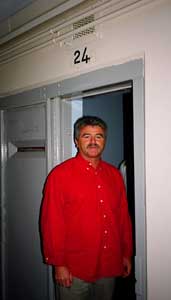
Arthur Morgan TD at the door of the first cell he occupied in H4

Arthur Morgan, Sinn Féin TD for Louth and party spokesperson on Enterprise and Employment, recently made a return visit to the H-Blocks of Long Kesh. Morgan was a political prisoner in the H-Blocks from 1977 to 1984, following his arrest by the British army aboard a boat in Carlingford Lough.

This week Arthur Morgan writes of the powerful memories generated by his return to Long Kesh.

It was at a homelessness conference in Brussels that it all began. Fra McCann and myself, housing spokespersons for Sinn Féin on both sides of the border, were in attendance at the request of Mary Lou McDonald MEP. Now, place any two republican ex-POWs together and inevitably the conversation will include a section on time in jail. And so it came to pass. The Blocks, in our case. “I can arrange visits” said Fra. “Excellent”, says I. “When can we visit?”.

It took Fra several weeks, but fair play to him, he was as good as his word, and we duly arrived at the infamous H-Blocks on the morning of Wednesday, 20th July. Fra was even on time which, in itself, was something of historical note.

Our team included Caoilfhionn Ni Dhonnabháin, my boss in Leinster House, Wendy Lyon and Shannonbrooke Murphy of the Leinster House team, Olive Sharkey who is my boss in Louth, and Marion, my wife and overall boss.

Never let it be said that I don’t know my place. John Blackmore, an ex-POW was also in attendance.

We arrived at the H-Blocks and gathered in the car park. Several minutes later our guide arrived. He was quite unusual for a civil servant. For a start, he was quite pleasant and secondly, he had a first name that suggested he might follow gaelic football.

We piled in to the ubiquitous ford van, similar to those which ferried thousands of visitors to meet their imprisoned loved ones in the H-Blocks over many years through the height of resistance to Britain’s occupation of Ireland.

First stop was the administration Block. Quite bleak at first sight, it is probably the only two-storey building on the 100-plus acre site at Long Kesh. Boy, when I think of how many of us would have given our right arm to get into this nerve-centre of control in its hey-day.

Anyway, here it was, lying open to the elements and bereft of the technological wizardry which helped the Brits keep some semblance of containment in the prisoner-of-war camp. Empty shelves, which once housed dozens of TV monitors, scrutinising virtually the entire camp, looked miserable.

In we went and, after some mild introduction, we moved to where we all wanted to see – the wards where the hunger-strikers were housed, many of them for their final days.

Ward Eight is where Bobby Sands died. We shuffled in, very respectfully and in silence, to stand by the bare bed in the centre of the otherwise empty room. The silence lasted for several moments, before someone asked if this was the actual bed once occupied by Bobby. Unlikely. However, we reflected on those painful, agonising moments that each of the hunger-strikers, their families and comrades endured during those most historic days.

After some time, we moved quietly down the hospital wing, looking into each of those small rooms and wondering how on earth they endured it. This was lump-in-the-throat time, big time. The empty medication trolley lying in the centre of the wing looked ghostly, and the peeling paint on the walls made it look like this was part of the dirty protest area, which of course it was not. Simply a case of time catching up.

Thoughts of the sadness and tragedy of those times, mixed with the progress and potential of these times. Mind racing. God it would take a book to hold all these thoughts.

After nearly half an hour, we slowly move on to our next stop, H-Block 4.

The visit should really call to H-Block 6 but, because of the killing of Billy Wright there, the scene remains sealed off. So on to H4.

This was most interesting for me, because here is where we -the ‘Provo Navy’, were deposited after being sentenced by a Diplock court in November 1978.

Memories came flooding back. Now I was walking through the open gate in the company of friends. In ’78 we were driven through in a blacked-out prison van and being greeted by the sound of banging chamber pots on cell doors by the blanketmen.

Most memorable, for me, was the repugnant smell as soon as we entered the Block on that November night. Disinfecting agents mixed with the obvious odour of the dirty protest. And then there was the welcoming party – a gang of screws, handpicked to ensure we understood how things would be. After some roughing-up, we were sent to A-Wing, where Peter Dullaghan from Dundalk and myself were shoved in to cell 24 and the door slammed heavily behind us.

On this occasion, we wandered freely down the wing and inspected cell 24 – just for old times sake. The cell was even smaller than I remembered. A bit like going back to your first school and marvelling at the tiny seats, perhaps.

I recounted one of the more interesting experiences at this cell- the forced washing in late December ’78. Prisoners were dragged from their cells, beaten, propped in a chair and hair and beards shaved, scraped off’ might be more accurate, before being washed with scrubbing brushes and held under water in a bath.

Some blanketmen were really brutalised in this process. I recall Tom McElwee and Kieran Doherty were hospitalised after they lashed out at screws who were beating the younger prisoners particularly badly. Everyone from that time has a story to tell.

Anyway, these wings were now quiet and deserted. Fra McCann regaled the visitors with numerous stories, ranging from his days on the Maidstone prison ship, to the internment camp and the burning of the Kesh. I knew Fra was a fair big age – he has certainly been about a very long time.

We finished our visit with a walk around some of the infamous ‘cages’, where both internees and POWs were held at a time when Britain accepted our POW status.

The Hospital Block, together with H6 and one of the cages is to be retained. Rightly so. This jail resonates with the same sense of history as Kilmainham in Dublin, where the leaders of the 1916 Rebellion were imprisoned and executed. It is also yet another monument to the failure of successive British and Dublin governments to resolve Ireland’s independence issue, once and for all.

Hopefully, our generation will ensure that there are no more Long Kesh camps.

H-Block Remembered – Tony Miller

Tony Millar pictured with former hunger striker and West Belfast MLA Pat Sheehan at a H-Block exhibition in the Gasyard Centre. (3009MM08)

‘I’ll never forget going into the H-Blocks’

Derry republican Tony Millar had already spent four years inside the North’s prisons before he was sent to Long Kesh at the height of the blanket protest in 1978 but said that nothing could have prepared him for what he found there.

Derry republican Tony Millar pictured after his arrest in 1977. (3009MM05)

Tony, who now works with ex-prisoners group, Tar Abhaile, said he can still remember the smell he encountered when he was led into the H-Blocks during the blanket protest by republican prisoners who were fighting the British government’s policy of criminalisation.

The Derry man was 18 years-old when he was first sent to prison in 1973 at a time when republican prisoners still had special category status. “I was taken to Crumlin Road jail, and after going through administration on B-wing, I was taken to A-wing, which was totally politicised and controlled by republicans. We were treated as political prisoners. The cell doors were opened in the morning and not closed until night. We had education classes, drilling, and operated as a military structure.

“That went on for twelve months and then the Diplock Court system came in and I was convicted and sent to Long Kesh for a month before being sent to Magilligan. We regarded ourselves as political prisoners and were treated as such,” he said.

Tony was released from Magilligan in 1977 and immediately became reinvolved in republican activities in Derry, leading to him being arrested again the following year in 1978 and sent back to Crumlin Road jail. By that stage, special category status for republican prisoners had been removed by the British government.

“We were going into a very different system,” he said. “They were trying to criminalise the republican prisoners. That is when I went on the protest. It was already started at that stage and prisoners refused to slop out or clean our cells. We then stopped using the toilet and threw the stuff out the window or onto the landing.

“The winter of 1978 was particularly severe and the sewers in Crumlin Road jail exploded, sending the waste onto the wing. It became pretty hostile at that stage and beatings by the screws were commonplace,” he said.

During his time in Crumlin Road, Tony came face to face with four of the Shankill Butchers.

“Things had got pretty bad and one day when I was going to get water a fracas erupted and I was taken to B-wing, which was a criminal wing, and put on punishment, or as we called it, behind the wire. Some of the Shankill Butchers were in there too, as I soon discovered.

“I went to the toilet one day and the toilets had half doors and I saw four pair of feet under the door. There was a knock on the door and I opened it, preparing for the worst, four of the Shankill Butchers were standing there. One of them said he knew who I was and that the screws had sent him in. I was expecting the worst but he said he was not going to play the screws’ game. I washed my hands and returned to my cell ” he said.

The Derry man was sentenced to nine years imprisonment in early 1979 and was sent to the H-Blocks of Long Kesh, an experience he says he will never forget.

“The hostility was unbelievable. When I went in they handed me they uniform and I said I would not wear it and stripped naked and said I was a political prisoner and that I wanted to go to the protest blocks.

“I was put into a van and taken to the blocks and I looked out through the slots on the van and saw the blocks for the first time. All the windows had been put out and I could see the space around each window covered with the waste the prisoners had thrown out. It was scary.

“I was taken out of the van, still naked, and faced a barrage of sectarian remarks before being forced to squat over a mirror while being hit by the screws. Then I was thrown into a cell, still naked, while I waited for them to bring me a blanket,” he said.

The first prisoner Tony encountered was Kieran Nugent, the first man to refuse to wear the prison uniform. “I was in the cell and heard a tapping on the pipe and it was Kieran Nugent. He told me what was what and I got to know him over the next 18 months,” he explained.

Shortly after Tony arrived in Long Kesh preparations began for the first hunger strike. “My abiding memory of the first hunger strike was the night it ended in December 1980. Pat McKeown was on the Camp Staff and on our wing and he was the one who gave us updates about what was happening. When Sean McKenna was nearing death I remember seeing him go off the wing and when he came back he spoke to us all in Irish. He informed us that the hunger strike was over . We soon realised there was nothing there and that the British had reneged . Deep down we were gutted but determined to fight on,” he said.

Tony said that all the prisoners knew there would be a second hunger strike. “After Christmas people started to talk about hunger strike again. My mother died in February 1981 and I applied for parole to attend the funeral and was given six hours parole. I had to go to Derry, pay my respects, and be back in six hours. Everyone was asking about what the situation was within the prison,” he explained.

When the second hunger strike began in March 1981, Tony knew many of those taking part. “Kieran Doherty was in the wing opposite me. I remember him as a big tall lad. When they rotated us in the cells I was put into his cell and saw all the poetry he had written on the walls. Raymond McCreesh, Thomas McElwee, and Kevin Lynch were also on the wing and I would have seen them at Mass on Sundays.

“When Bobby Sands was elected morale was great but when he died we were devastated.

“When Bobby Sands died Bik McFarlane was on our wing and told us the news and you would have heard a pin drop. We all knew he was going to die but there was silence when we heard.

“Francis Hughes was on the wing and the night before he went on hunger strike he gave a speech and said he was a fighter both outside and inside and inside he had no weapons except his body to fight with. That has stayed with me for a long time ,” he said.

Tony said he has clear memories of the day the hunger strike ended. “The day it finished I was out on a visit and another prisoner shouted to me that it was coming to an end and for me to tell my OC. I went and reported back and later that day we were told it had ended. There was relief that no more would die but the talk turned to what the next step would be.

“The strategy changed and within six years the whole system had been changed too. It had returned to the way it was when we had status. I got out in 1983 but was back in prison in 1990 and went back into an entirely different place. It was totally changed and run by republicans. We had classes, discussions, debates and were treated as political prisoners. That was all because of the hunger strike,” he said.

Tony also said the spirit that drove the hunger strikers still exists today among republicans. “Bobby Sands was the man who told us not to lie down and take it and to challenge the system. That is still happening today but in a different way.

“The prisoners broke the system from within the jails and since then republicans have used that same spirit and dedication to go forward in achieving our political objectives ,” he said.

Armagh Jail Remembered – Mary Doyle

‘When your back is against the wall, you get the strength from somewhere ’
Mary Doyle Irish Republican

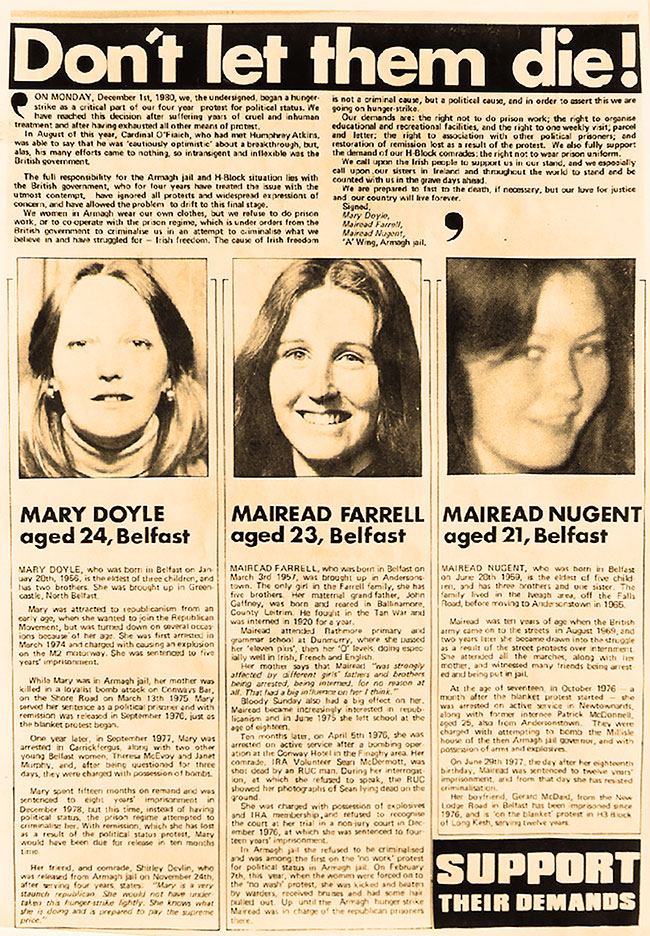
THE 1981 Hunger Strike was a direct result of the withdrawal by Margaret Thatcher’s British Government of political status for Irish republican prisoners and her administration’s intransigence after the 1980 Hunger Strike. MARY DOYLE took part in the 1980 Hunger Strike as a POW in Armagh Jail.
Mary was released from jail in 1983 and has been involved in republican activism since then. She is currently standing as a candidate for Sinn Féin in the Belfast City Council elections in May and works for the party in the Teach Carney constituency centre in north Belfast.
She looks back to the traumatic years of the 1980 and 1981 Hunger Strikes.

NORTH BELFAST republican Mary Doyle was first sent to Armagh women’s jail for republican activities in May 1974 when she was 18 years old.
“At that stage we had political status,” she recalled.
In 1975, while Mary was in jail, her mother was murdered by the UVF. She was allowed out for 24 hours on compassionate parole to attend her mother’s funeral, then returned to the jail.
“That was a very dark period for me but the comradeship of the women got me through,” Mary said.
“I was released in September 1976 and political status for prisoners had been withdrawn in March that year. I was sent back to jail in September 1977 and the prison Screws and governor took great pleasure in telling me that status was gone and that I was an ‘ordinary criminal’. I was on remand and then sentenced in December 1978.”
In 1977, the republican women POWs in Armagh refused to do mandatory prison work in protest at the withdrawal of political status. In response to the no-work protest, the women were kept in their cells all day during work hours and were allowed out between 5:30pm and 8pm in the evening to eat, wash and exercise.


Punishment for the work strike also included the loss of educational opportunities and remission. One visit a week was reduced to one visit a month.
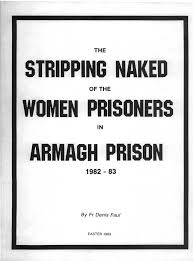
Strip searches were a key weapon used by the prison authorities throughout this period in an attempt to intimidate and humiliate the republican women. This process, condemned as a form of sexual assault by the state, involved women being thrown to the ground and beaten if they resisted.
While the men in the H-Blocks of Long Kesh had begun the blanket protest in protest at the British Government’s criminalisation policy, refusing to wear the prison uniform, Armagh prisoners were allowed to wear their own clothes.

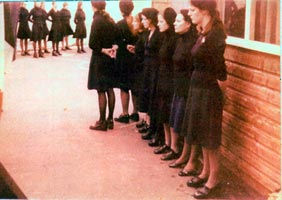
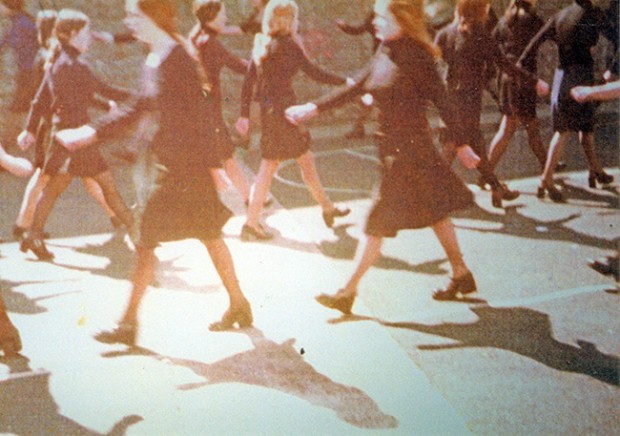
The women wore IRA uniform items such as black polo-neck shirts, black skirts and tights as a form of protest against criminalisation.
“We would organise commemorations in the yard wearing our uniforms if a Volunteer was killed,” Mary said.
“In February 1980, a major raid was carried out on our cells by male and female Screws. They moved us into two association rooms while they ransacked our cells. We didn’t have much but what we had – photographs, letters and personal items – they destroyed.
“We then had to walk back to our cells through lines of male Screws on either side who came out with all sorts of abuse.
“We were locked up for 24 hours a day and denied access to toilet facilities. This went on for a few days and a small amount of cold food was thrown in now and then. We had a chamber pot in the cell and tried to empty it out under the door when it was full but the Screws brushed the waste back in.

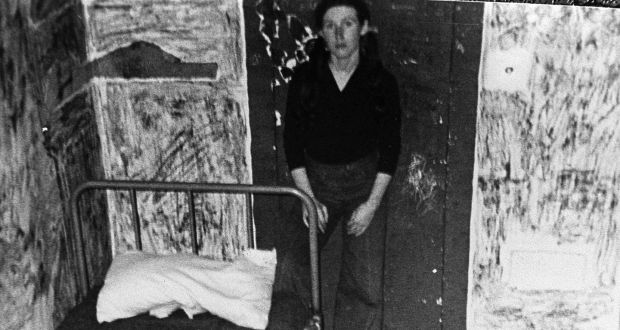
Mairéad Farrell on the no wash protest


“Mairéad Farrell, who was our O/C [Officer Commanding], was protesting strongly to the prison administration, demanding that we be allowed out of our cells for an hour a day, which was our human and legal right.
“After a few days we were allowed out for an hour’s exercise, four at a time – but the toilet facilities remained locked.
“The no-wash protest was forced on the women in Armagh through the actions of the prison authorities.”
The republican prisoners were moved from ‘B Wing’ to ‘A Wing’ where they spent the summer of 1980. The men in the H-Blocks had at this point been on the blanket and no-wash protest for several years.
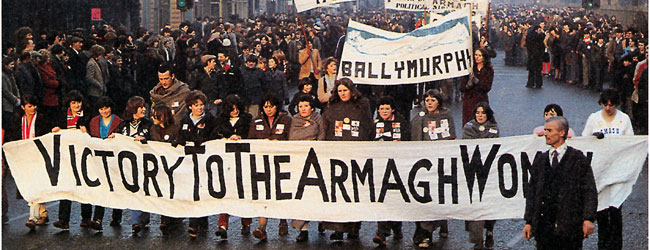
“There was great communication between the H-Blocks, Armagh and the republican movement outside,” Mary explained.
“There were 30 republican women prisoners and we only got one visit each per month, so we made sure that a woman had a visit from the outside each day to keep up the communication.
“The question of beginning a hunger strike began to be discussed. It was firmly opposed by the leadership on the outside. But for us and for the men in the H-Blocks, we felt our situation was intolerable and we needed to try to force a change in our conditions.
“The H-Block leadership was opposed to women participating in the hunger strike. This wasn’t for any macho reason – their opposition was based on logistical issues. But the women were determined to participate as we felt we had an equal stake in achieving the five demands.”
Mary explained the process of deciding to volunteer for the hunger strike.
“I thought long and hard about volunteering for the strike before I put my name forward. My main consideration was my family. My mother had been murdered, my father was unwell and I had two younger brothers. I was approaching my 25th birthday.
“After a lot of consideration I took the decision to put my name forward. Seven men in the H-Blocks began the hunger strike on October 27th. On December 1st, Mairéad Farrell, Mairéad Nugent and myself joined the Hunger Strike.


“Telling my family was very difficult emotionally.
“When there had been talk on the outside of a hunger strike, my father had said to friends and family: ‘Oh, our Mary will definitely put her name forward.’ They supported me and that was amazing, to have the support of family, friends and comrades.
“On the day we started the hunger strike, the three of us were moved to a double cell together, which was great for us in terms of morale. We would spend the days writing letters to anyone and everyone around the world about the plight of the prisoners.”
Mary noted that “prison food is notoriously bad” and said that Armagh was no exception.
“The food was usually served cold and in small portions. But when we started the hunger strike, the screws would pass in plates overflowing with piping hot food,” she said.
“The cell would never be without food. The uneaten suppers would remain in the cell overnight and be removed only when breakfast was passed in. That was something really petty, really childish and vindictive, on the part of the prison authorities that I remember being disgusted with.”


As the three women entered their second week on hunger strike, they were moved to the so-called ‘hospital wing’ – a double cell in another part of the prison. They were allowed use the bath facilities, which was a requirement for everyone entering the hospital wing.
“We had been on the no-wash protest since February that year and having a bath had been something we had been looking forward to so much, and talking about eagerly,” Mary recalled.
“But by that stage we were actually too weak to really appreciate it.
“Communication with the other prisoners remained good as we were still allowed an hour’s exercise in the prison yard. But it was December and we were very conscious of the threat to our health from the cold, with our weakened immune systems. We wrapped up in extra blankets to try to keep warm.
“Despite the physical hardship, our morale was brilliant. Our only concern was the health of our comrades in the H-Blocks who had been on hunger strike longer than us. Then we heard that Seán McKenna’s health was rapidly deteriorating.
“We had a small radio that we’d smuggled in to the cell that we listened to only at news time. On December 18th we heard an item on the nine o’clock news that said the hunger strike had ended. We thought we had misheard it but the same news was repeated the following hour.
“Danny Morrison had tried to get in to visit us that evening to inform us of the decision to end the hunger strike but the prison authorities and NIO officials refused to allow him in.
“The Armagh prison governor, George Scott, came in to us saying, ‘So, the hunger strike is over.’ But we hadn’t had confirmation, so Mairéad said: ‘No. We’re still on it until we hear directly that it’s over.’
“After a visit by a republican to acting O/C Síle Darragh the following day, December 19th, we ended the hunger strike. Our immediate reaction was relief that Seán McKenna would live and a sense of happiness or satisfaction that our demands, as we believed, would be met.”
Mary recalled the rapid disillusionment in Armagh and the H-Blocks as shortly after Christmas it became clear that the British had no intention of addressing the five demands.
“In January, we began discussing a second hunger strike. I was all for it. I put my name down again as did a few others,” she said.
“My father had visited me after the hunger strike ended, and I will never forget the look of relief in his eyes.
“I thought about what it would mean to put him and the rest of my family through that again. It was a very difficult decision, and something that I felt and still feel truly terrible about but I felt I had to remove my name.
“There were only 30 prisoners in our wing in Armagh Jail, including some women who were not even part of the Republican Movement but who had been forced into signing confessions in Castlereagh. We made the assessment that we would not have the capacity to sustain a second hunger strike in Armagh.
“When Bobby Sands started the second hunger strike in 1981, the no-wash protest was called off in the H-Blocks and Armagh so the POWs could focus on the hunger strike. We were still on the no-work protest so we were still locked in our cells all day but managed to keep up communication in our time out of the cells in the evenings.
“There was a huge buzz among us when Bobby was elected as MP in the Fermanagh/South Tyrone by-election. We were convinced – certain – that there was no way Thatcher could let him die after that.”
Mary described the morning the Armagh women heard that Bobby had died.
“There aren’t any words to properly describe the way I felt. It was every emotion at once – heartbreak, shock, fury and frustration – and all the time you were locked in a cell all day, not able to take any sort of action like protesting on the streets.
“My heart ached for each of the families. The loss didn’t lessen as each of the ten men died. The pain just grew and grew.
“But the comradeship sustained us. When we had nothing else, we had each other.
“Armagh Jail was an old Victorian building. It was freezing. It wasn’t pleasant. The conditions when we were slopping out were grim and not something you thought you could ever get used to.
“But when your back is against the wall, you get the strength from somewhere. And republicans, we just get on with it. We always have.”